
A Christmas Carol Parent Guide
The perfect tonic for the soul.
Parent Movie Review
 When my son asked what my favorite part of the holiday season was, I sassily replied “Vacuuming up the pine needles after we have taken down the tree.” Appalled, both he and my husband pronounced me a “Scrooge.” Diagnosed with an ailing Christmas spirit, it was suggested that the best cure might be spending time with the man who’s name has become synonymous with a “bah humbug” attitude.
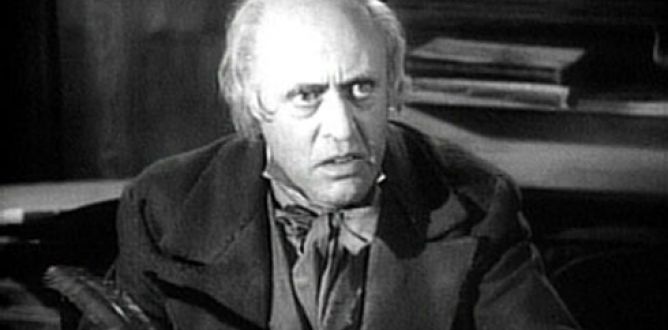
With countless adaptations of the familiar Dickens’ tale available, I chose to fill my prescription with the 1951 version staring Alastair Sim. Then I gathered my children around the glowing TV to share the medicine.
 Even though it is missing all the colors (as my youngest child quickly pointed out), there is something very powerful about this traditional telling of the miserable miser who receives a very unusual Christmas present from his long deceased business partner. As Ebenezer Scrooge, Sim exudes sentiments of “you shouldn’t have” when he is promised visits from three ghosts who hope to help him catch the spirit of the season. The apparitions personifying Christmas past, present and future, provide glimpses into Scrooge’s neglected childhood and consequent self-centered pursuit of wealth that fashioned him into a jaded and bitter old man. While the first two specters are gentle and jolly, the third (draped in dark flowing fabric) is rather frightening-especially in black and white. After a pause of the tape and some reassurances, we continued the movie to see Sim’s brilliant and witty performance as his greedy character is transformed by the joy of giving.
Judging by the story’s enduring popularity, I’m not the only one who has traits in common with Mr. Scrooge, or who finds the associated commercialism and stresses of the season robbing me of its promised peace. A Christmas Carol (known as Scrooge in the UK) provides portrayals of Bob Cratchit’s (Mervyn Johns) humble gratitude, Tiny Tim’s (Glyn Dearman) faith and optimism, combined with a message of possible reformation for those of us who have (for the moment at least) lost sight of what matters most, making it the perfect tonic for the soul.
Directed by Brian Desmond Hurst. Starring Alastair Sim. Running time: 96 minutes. Theatrical release December 2, 1951. Updated July 17, 2017About author

A Christmas Carol
Rating & Content Info
Why is A Christmas Carol rated Not Rated? A Christmas Carol is rated Not Rated by the MPAA
Overall: A
Alastair Sim is the perfect Ebenezer Scrooge in this 1951 black and white version of Dickens’ classic tale. Although the ghostly visitors may be a little scary for very young viewers, the reminders of Christmas’ true meaning and “Mankind is our business” are messages that can “...bless us, everyone.”
Violence: B+
The helpless plight of the poor and homeless is depicted throughout the film. Ghostly apparitions portrayed, one in dark hooded cloak has “grim reaper” appearance. Character occasionally screams or whimpers in fear. Unexplainably, bell rings, clock chimes, and door flies open. Deaths of ailing man and woman shown. Frightened woman screams and runs away from man who appears crazy.
Sexual Content: A
Embracing man and woman exchange ring. Man affectionately kisses woman on two occasions.
Language: A
At least: one term of Deity exclaimed in prayerful fashion.
Alcohol / Drug Use: A-
Gin punch served at dinner. People make toasts at social gathering. Man claims he is “as giddy as a drunken man.”
Miscellaneous:
Character justifies embezzlement. Several characters use unfair advantage to secure business deals. Thin and scantly clad beggar children shown. Characters justify stealing from dead man.
Page last updated July 17, 2017
A Christmas Carol Parents' Guide
The Ghost of Christmas Present opens his long robe to reveal two impoverished children seeking shelter underneath it. The Spirit introduces the girl as “Want” and the boy as “Ignorance.” What do these figures represent? Why are they clinging to Christmas? Why does the Spirit warn Scrooge to beware of them, especially the boy?
The neglect suffered in his youth appears to motivate Scrooge to place his own needs ahead of everything else. How did that decision contribute to the loneliness he experiences in later life?
At the end of the film Scrooge declares, ” I don’t deserve to be so happy.” What is the source of his happiness? How does the life of Scrooge illustrate “It is more blessed to give than to receive?” Can everyone find joy this way?
Home Video
The most recent home video release of A Christmas Carol movie is November 1, 2011. Here are some details…
Home Video Notes: A Christmas Carol: 60th Anniversary Diamond Edition (1951)
Release Date: November 1, 2011
A Christmas Carol releases to DVD and Blu-ray in a 60th Anniversary Diamond Edition on November 1, 2011. (The Blu-ray has been digitally restored from a new 1080p, 24fps high definition transfer master produced from the 35mm negative and fine grain.)
- Commentary Tracks By Marcus Hearn and George Cole
- Introduction by Leonard Maltin
- Dead to Begin With: The Darker Side of A Classic—Documentary exploring the films bleaker themes and how they rivaled London of the 1950’s. Featuring British film historian and culturalist Sir Christopher Frayling. (25 mins)
-Scrooge By Another Name: Distributing A Christmas Carol—Featurette detailing the American release of this British holiday classic. Featuring US distributor Richard Gordon. (10 mins)
- The Human Blarney Stone: Life and Films of Brian Desmond Hurst—Documentary chronicling the life of Ireland’s most prolific filmmaker. Featuring Allan Esler Smith, the great, great nephew and biographer of Hurst. (40 mins)
- A Scholar’s View—Video narrative by Fred Guida, author of A Christmas Carol and Its Adaptations (35 mins)
-Silent Dickens—Collection of early examples of Dickens on film. (includes HD: Scrooge -1922, Bleak House 20 mins)
Bonus DVD
- More Silent Dickens (A Christmas Carol 1914, Scrooge, or Marley s Ghost 1901, Scrooge 1913)
- Campbell’s Playhouse: A Christmas Carol—Digitally remastered version of original 1939 radio dramatization, narrated by Orson Welles and starring Lionel Barrymore. (Audio only. 54 mins)
- Bibliographic Essay—by Fred Guida (10 mins)
Holding true to the literary masterpiece on which it is based, the 1951 rendition of A Christmas Carol (also known as Scrooge in the UK) provides a perfect Ebenezer Scrooge thanks to the masterful performance of Alastair Sim. You’ll laugh, you’ll cry and you’ll be reminded that giving of oneself is where the true joy of Christmas will be found. You’ll also have an opportunity to explain to your children that all TV used to be black and white (that’s why it was called the dark ages…right?) Parents should also be aware that youngsters might find the ghosts a little frightening.
Related home video titles:
For a lighter (and more colorful) interpretation of this story try A Muppet Christmas Carol. Another Christmas film that explores the value of selfless giving is It’s A Wonderful Life.
Related news about A Christmas Carol