Old Yeller Parent Guide
Parent Movie Review
Although I never saw Old Yeller when I was a child, my husband distinctly recalls the day it was shown as a special treat in the rural elementary school he attended. A newcomer from the city, he sites that moment as the one where he lost all hope of maintaining any sort of manly image in the eyes of the seasoned farm kids who were now his peers. Right after Bambi, it was the most traumatic movie experience of his young life.
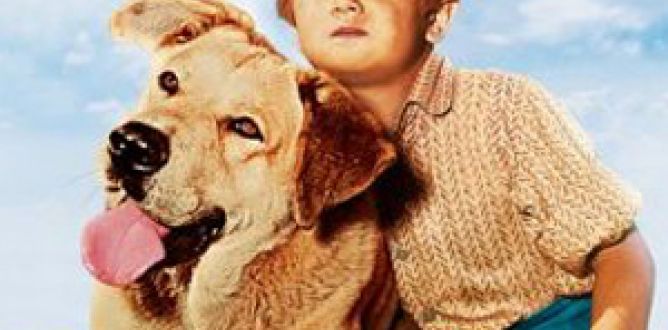
For all his embarrassment, I suspect he wasn’t the only one to shed a few tears. Tugging on the heartstrings of anyone who has ever felt puppy love, this Disney film tells the story of a stray, yellow-haired mongrel that takes up residence on a Texas frontier ranch.
Helping himself to their provisions, the thieving mutt is at first not welcomed by fourteen-year-old Travis (Tommy Kirk). However, the brown-eyed brute manages to steal the affection of little Arliss (Kevin Corcoran), and solicit sympathy from the boys’ mother (Dorothy McGuire), who would like the animal’s protection while her husband (Fess Parker) is away. Before long the disheveled dog proves himself so indispensable that the family (and especially Travis) don’t know how they ever got by without him. But complaining neighbors, run-ins with wild creatures and an epidemic of hydrophobia (also known as rabies), may put an end to the happy relationship.
Cherished as a family classic for close to fifty years, the movie still presents some concerns for children (citified or otherwise), who might not be as comfortable with hunting and killing wildlife, or the harsher realities of dealing with livestock. Moments of peril and depictions of bloody wounds also play a part in this drama of 1860s western life. (Not to mention some moments of political incorrectness.)
Yet, I suspect what has endeared several generations to this film may be its themes of love and loss. Based on a novel by Fred Gipson, this coming-of-age story demonstrates the qualities needed to make a boy a man—hard work, a willingness to shoulder responsibility and a determination to do what needs to be done—even if it breaks your heart (and makes you cry in front of your whole class).
Updated March 16, 2009
About author

Old Yeller
Rating & Content Info
Why is Old Yeller rated G? Old Yeller is rated G by the MPAA
The practical realities of surviving on the Texas frontier (although presented in a sanitized fashion) include the need to hunt and kill, as well as treat livestock like animals—not pets. The squabbling siblings exchange threats to the point where one throws rocks at the other. Humans, dogs and wild animals fight, resulting in bloody injuries and even death. Some depictions of women and Indians may be considered politically incorrect by contemporary standards.
Page last updated March 16, 2009
Old Yeller Parents' Guide
The move mentions a disease called “hydrophobia,” which is now known as rabies. To learn more about this fatal illness, check out this site.
The mother in the story tries to protect young Arliss, from some of the ugly reality they must face as well as the consequences of letting his imagination run wild. Why do you think she does this? How does this effect the young boy’s behavior?
Home Video
The most recent home video release of Old Yeller movie is November 14, 2005. Here are some details…
Related home video titles:
Dog stories have long been the silver screen’s best friend, with such tail-wagging tales as Lassie, My Dog Skip, and Far From Home: The Adventures Of Yellow Dog (quite possibly Old Yeller’s cousin!).
Related news about Old Yeller