
Nuremberg Parent Guide
Brilliant writing and acting make this an unmissable choice for audiences who like serious historical films.
Parent Movie Review
It’s the end of World War II and the victorious Allies face a perplexing question: what should they do with the surviving leaders of the Nazi regime? Despite pressure for summary executions, US Supreme Court Justice Robert H. Jackson (Michael Shannon) is convinced that only a trial can publicize the monstrous evils of the Nazi regime, squash support for a potential resurgence of Nazism in Germany, and inoculate the rest of the world against future war crimes. To everyone’s surprise, allied governments agree, and Justice Jackson finds himself in Nuremberg, working with a multinational team of prosecutors to bring Nazi leaders to trial.
Douglas Kelley (Rami Malek) is a small cog in the vast machinery of military justice. The American psychiatrist is assigned to a secret prison which holds high value Nazi prisoners, and his job is to prevent suicides and ensure the prisoners are fit to stand trial.
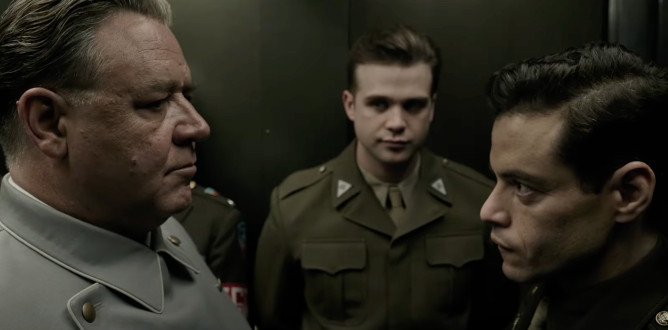
Of the first 22 men indicted to stand trial, the most prominent is Hermann Göring, Reichsmarschall of Germany, head of the Luftwaffe (Air Force), and Adolf Hitler’s second-in-command. Göring (played by Russell Crowe), is a complex figure: narcissistic, grandiloquent, supremely confident, and convinced he will escape the hangman’s noose. Kelley is fascinated by Göring and believes that if he can understand his patient/prisoner, he might be able to “dissect evil” and figure out how to prevent future atrocities. Thus begins the relationship between the two men as sparring partners, borderline friends, and antagonists.
Films like Nuremberg are the reason I still go to the movies, despite the relentless tide of mediocre films that fill my schedule. This is a brilliant production, with some of the best screenwriting I’ve enjoyed in a long time. The dialogue is tight, tense, and convincing, and is lightened with just enough dark humor to remind us of the humanity of the people involved. This is a film that will keep you at the edge of your seat, which is no small achievement in a historical movie where we all know the outcome.
Nuremberg also benefits from superb acting, with a nuanced performance by Rami Malek who struggles both with his feelings towards Göring and with the tension between his obligations as a doctor to put his patient’s confidentiality and needs first and his obligations as a soldier to share information with his superior officers. But the star of this show is Russell Crowe, who turns in an Oscar-worthy performance as Göring. He fully inhabits this contradictory man: proud, vain, devoted to his family, lacking in conscience, brilliantly manipulative, and also vulnerable. We all know that people can be monsters, but Crowe makes us ask if monsters can also be people.
Despite Crowe’s ability to humanize a Nazi, there is no whitewashing of the Holocaust in Nuremberg. The trial features a black and white movie depicting concentration camps, and the repeated images of starved corpses and crematoria ovens triggered audible sobs from the woman sitting behind me. (Parents and teachers can take note that none of this film’s imagery is more graphic than any documentary on the topic). There are no other gruesome images, but the bleak horrors of the time are impossible to ignore, and the movie’s PG-13 rating is a good guide as to who should watch the film. Other negative content is minor – 18 profanities, some brief smoking and drinking (including a scene of intoxication) – making this a good choice for anyone interested in discussing the big questions this movie examines. The discussion will certainly be painful, but that’s the point: anything else misses the lessons of history.
Directed by James Vanderbilt. Starring Russell Crowe, Rami Malek, Richard E. Grant. Running time: 148 minutes. Theatrical release November 7, 2025. Updated November 6, 2025About author

Watch the trailer for Nuremberg
Nuremberg
Rating & Content Info
Why is Nuremberg rated PG-13? Nuremberg is rated PG-13 by the MPAA for violent content involving the Holocaust, strong disturbing images, suicide, some language, smoking and brief drug content.
Violence: In the aftermath of war, there are frequent scenes of bombed out. Soldiers point a gun at a vehicle until the occupant surrenders. People commit suicide by poison and hanging and their dead bodies are seen. A man is hanged and loses bladder control as he dies. A movie shows the horrors found at concentration camps: stacked corpses and starving survivors. Crematorium ovens are seen and a bulldozer pushes corpses into mass graves. Soldiers point guns at a vehicle carrying an opposing commander. A man suffers a non-lethal heart attack on screen. A man is punched in the face. A man is hit with shovels below the screen and is later seen with injuries. A man escapes a plane crash. Men push and shove each other against walls.
Sexual Content: A man repeatedly says that abstract images look like female genitalia. There is mention of adultery.
Profanity: The script contains a half dozen terms of deity, five scatological curses, four minor profanities, and two crude terms. Jews are insulted by Nazis.
Alcohol/Drug Use: Main characters occasionally smoke cigarettes and cigars. Adults drink alcohol and a main character becomes intoxicated, with serious consequences. A doctor casually takes an opioid medication belonging to someone else. There’s mention that a prisoner takes 40 opiate pills a day.
Other: A soldier urinates on the ground. A hanged man loses bladder control as he dies.
Page last updated November 6, 2025
Nuremberg Parents' Guide
You can learn more about the Nuremberg trials and the people involved below:
Scientific American: The Nazi and the Psychiatrist
Wikipedia: Douglas Kelley
Wikipedia: Hermann Wilhelm Göring
BBC: Jewish US army translator who got close to the Nazis
Aish.com: Inside the Nuremberg mind
Holocaust Encyclopedia: Nuremberg Trials
University of Oxford: Nuremberg war crimes trials 70 years on: a complex legacy
Nuremberg Museums: Birth of international criminal law
Loved this movie? Try these books…
This film is inspired by The Nazi and the Psychiatrist by Jack El-Hai, which examines Douglas Kelley’s complex relationships with the Nazis he tried to understand. Kelley later wrote books based on his experiences – Twenty-two Cells in Nuremberg and The Case of Rudolph Hess. Helen Fry’s book, Inside Nuremberg Prison: A Biography of Howard Triest tells the story of the young German American translator who aided Kelley and other psychiatrists.
For more information about the groundbreaking trials at Nuremberg, you can read The Anatomy of the Nuremberg Trials: A Personal Memoir by American prosecutor Telford Taylor. Kelley’s colleague, Gustave Gilbert authored Nuremberg Diary, sharing details of his interviews with the Nazis he examined. For an easy read, you can try Nuremberg: Infamy on Trial by Joseph E. Persico. And for a comprehensive record, you can go to Ann and John Tusa’s The Nuremberg Trial.
Home Video
Related home video titles:
The classic film about the Nazi reckoning is Judgment at Nuremberg, which stars the late, great Spencer Tracy as a judge presiding over a trial of collaborationist German judges. Decades after the war, a young West German prosecutor is shocked to learn about his country’s dark past: he determines to bring war criminals to justice in Labyrinth of Lies. Another tale of bringing Nazis to justice is Operation Finale, the story of an Israeli secret mission to capture Adolf Eichmann and prosecute him for war crimes. In Woman in Gold, the Nazi’s thefts against Jews are brought before the courts decades after the war.